The Breakdown
 |
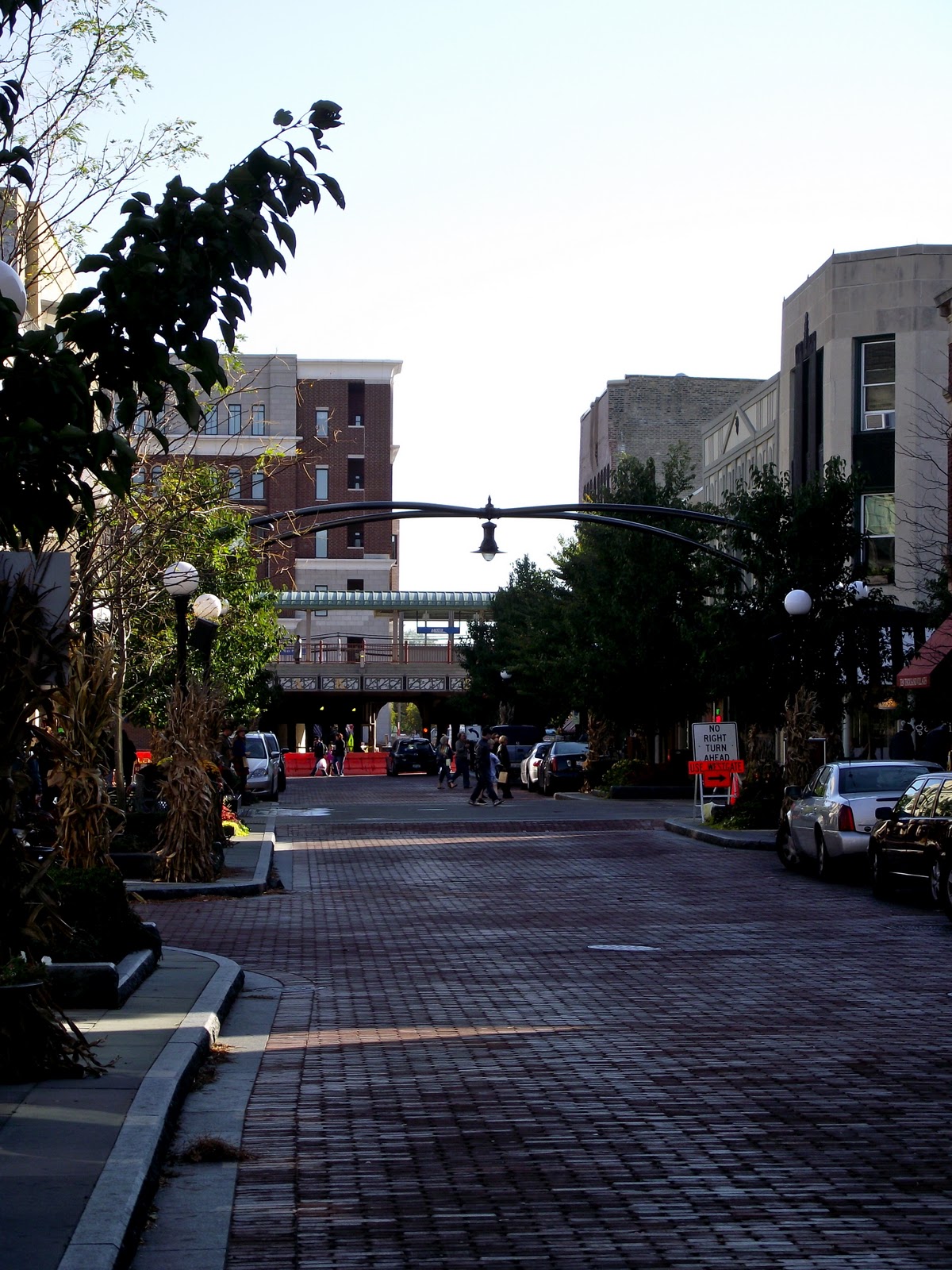
| The intersection of Lake & Marion in downtown Oak Park |
An overview: Few towns, let alone cities, can lay claim to
being home to the “greatest” of his or her profession. Oak Park can lay claim to two
unquestionable geniuses.
Frank
Lloyd Wright maintained his home/studio here from 1889-1909,
and Oak Park still bares the largest collection of his work in any one
area. During the time America’s
premier architect resided here,
Ernest Hemingway
was born in 1899 only two blocks away.
Coincidence? Probably. But still quite the amazing
coincidence.
There may not be any scientific reason that the town was
home to two of our country’s greatest artists, but their genius certainly
wasn’t groomed in poverty. Oak
Park was, and remains, one of the most beautiful communities you’ll come
across. Modern mansions mix almost
seamlessly with hundred-year old residences of striking beauty. The downtown continues to thrive with
shops, restaurants, and a vintage movie palace.
 |
| Looking southward down Marion Street |
Oak Park is the first of what will likely be several entries
on individual suburbs. While the
main focus of the blog is on Chicago’s neighborhoods, it’s also a chance to
reflect on communities that have thrived thanks to the Windy City’s
influence. Due to its immediate
proximity, Oak Park will always be inextricably tied to Chicago. It is absolutely worth multiple visits
for architecture buffs, foodies, history lovers, or anyone who enjoys walking
along lush tree-lined streets.
The boundaries: Unlike virtually every other Chicago suburb
(many of which look like an ink blot), the City of Oak Park is a perfect
box. The boundaries of the city
are North Avenue to the north, Roosevelt Road to the south, Austin Boulevard to
the east, and Harlem Avenue to the west.
The downtown is another interesting beast. Most downtowns are also called “central
business districts” because they’re, well, centralized within the
community. Oak Park’s downtown is
AS FAR WEST AS YOU CAN GO within the town. It starts west at Harlem Avenue and runs a few blocks east
to about Kenilworth Avenue. Lake
Street runs right through the heart of the downtown. There’s a large commercial district west of Harlem Avenue
that is more of a strip center and doesn’t really match the downtown feel of
Oak Park. That’s because west of
Oak Park is actually River Forest north of the train tracks, and becomes Forest
Park south of the tracks. Oak
Park, Forest Park, River Forest…got it?
Good.
Population make-up: The population of Oak Park dropped slightly
as of the
2010
Census. The 2010
population was 51,878 down 1.2% from 2000. The racial make-up of Oak Park as of last year was 63.8%
white, 21.2% black, 6.8% Hispanic, and 4.8% Asian.
 |
| Frank Lloyd Wright Home and Studio |
A brief history: The area around Oak Park was
first settled in 1835, but didn’t
experience any real growth until just after the Civil War and the Great Chicago
Fire that followed six years later in 1871. It seceded from Cicero in 1902, becoming its own
municipality. It grew
exponentially throughout the first half of the 20
th century, and
successfully embraced racial demographic change
in the early 1960s. Throughout its
history, it has been home to many notable residents, not only Hemingway and
Wright, but also
Edgar
Rice Burroughs (creator of
Tarzan and author of numerous beloved novels) and
Ray Kroc who turned McDonald’s from a local
burger joint into a worldwide phenomenon.
Although the population has decreased noticeably from its
1940 high of 66,000 residents, Oak Park has
held its position as one of Chicagoland’s most beloved destinations. In 2010, the Frank Lloyd Wright
Historic District was named one of the APA’s (American Planning Association)
“10 Great Neighborhoods”. Despite the westward growth of the
Chicago metro area, Oak Park remains one of its true gems.
Getting there: By “L”, you’ve got multiple options. The Green Line will take you right to
downtown if you get off at Harlem/Lake or the Oak Park stop. There are also Green Line stops at
Ridgeland and Austin. The Blue Line makes
stops in the southern part of town at Harlem, Oak Park, and Austin.
CTA bus isn’t likely your best option, but you can get there going east-west via North (72) and Lake (20). Going north-south you can take Harlem
(90), Ridgeland (86), and Austin (91).
There are also multiple
PACE
routes that will get you around Oak Park: 305, 311, 315, 318,
and 320.